First steps to teleoperation
Flex sensors, a RealSense T265 and a 3D-printed bracket on a glove. Cheap, smooth, and not scalable.
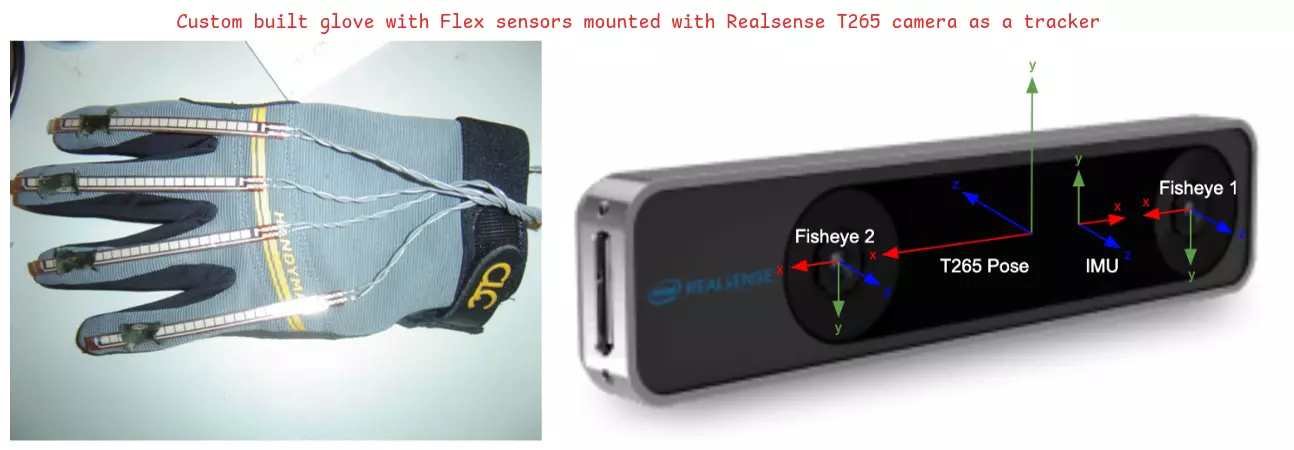
I built a simple teleoperation glove to control a robot gripper in real time.
- Flex sensors sewn onto the fingers, linearly mapped to gripper width: bend more, it closes more.
- A RealSense T265 tracking camera on a 3D-printed bracket stitched to the glove gives smooth 6D hand pose.
So I control both where the hand is and how far the gripper is open. It feels surprisingly natural.
Why it’s nice
It’s very cheap compared to motion capture or exoskeletons. A basic glove, a few flex sensors, one tracking camera and a printed mount. For quick demos or simple manipulation, it works quite well.
Why it doesn’t scale
- Wobbly mount. The glove fabric is thin and soft, so the T265 wobbles and small shifts add tracking noise.
- End-of-life hardware. The T265 is discontinued and I have one. No second hand, no humanoid hands, no multiple operators.
A nice low-cost prototype, but not a platform without rethinking the tracking hardware.
That rethink became the SenseGlove + Vive setup.